
Have you ever felt that apps like Spotify are the modern-day equivalent of a psychic?
Seriously, those AI-curated playlists are becoming too personal it's haunting. Don't even get me started with the suggestions! You enter for some good old calm music and end up jamming to Taylor Swift.
And the scary part?
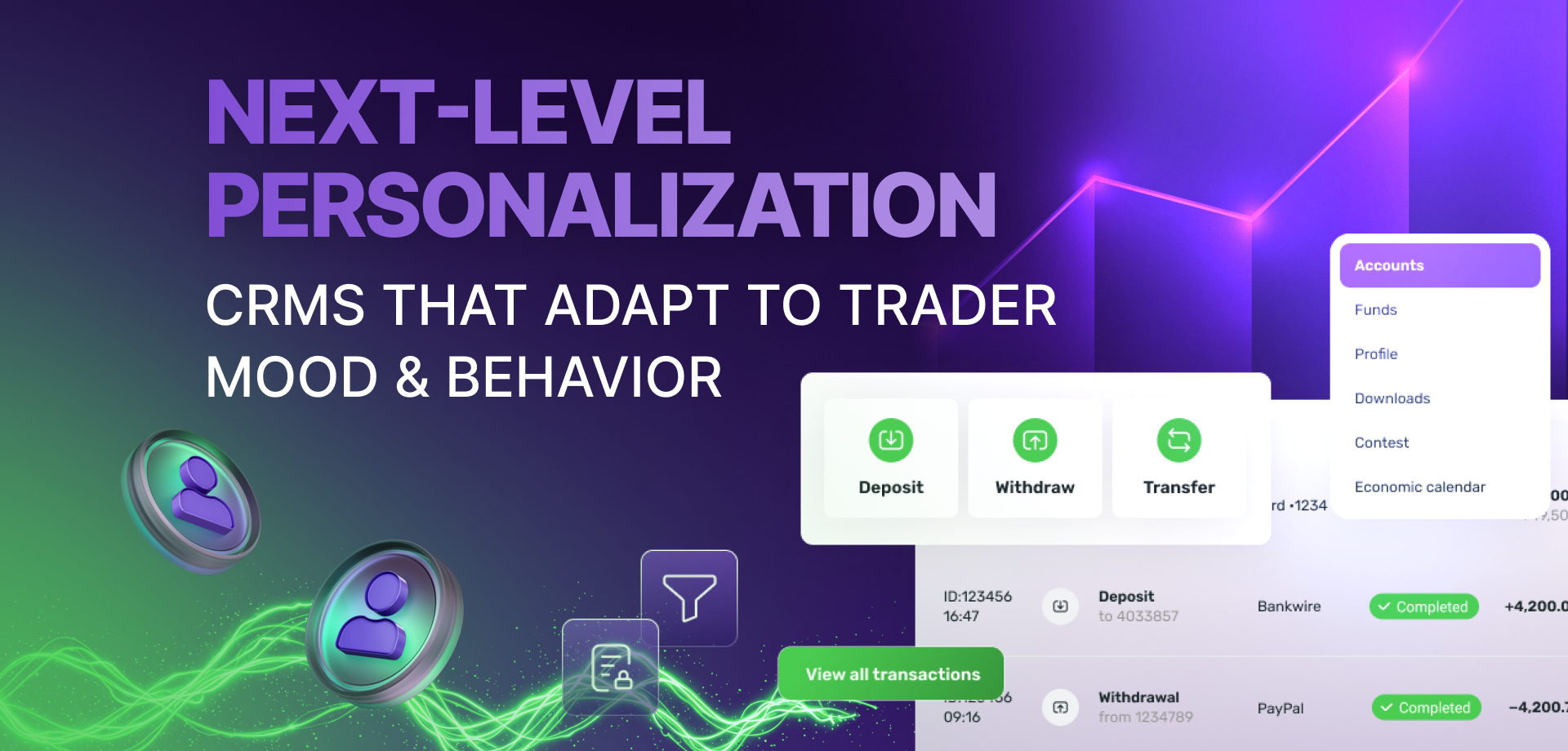
It feels so right. Now imagine a CRM that reads traders the same way. What would next-level personalization in Forex CRMs look like?
Why Personalization in Trading Platforms Is Missing the Point?
For years, personalization in trading platforms has meant organizing people neatly. From balance size, region, trading history, to maybe a few behavioral labels if the system is feeling generous.
Organized, impressive, and missing the whole point, because it assumes something that simply does not exist: consistency in behavior.
A trader is not a stable data point, and the data already proves it.
A 2024 experiment by the Financial Conduct Authority showed that something as simple as a push notification increased trading activity by 8%. Add gamified elements like rewards or leaderboards, and that number climbs further, along with a measurable shift toward higher-risk trades.
Same trader, different environment, but a different behavior. That should raise a more interesting question.
If systems can influence behavior that easily… why are they still so slow at understanding it?
Forex CRM Personalization 101: Trader Behavior Is Fluid
Go back to your music app for a second. It does not treat you like a fixed personality but rather adapts to versions of you. Late-night you, focused you, restless you...
Trading works the same way.
-
There is the disciplined trader.
-
And then there is the version that shows up after three losses in a row.
-
There is the patient strategist.
-
And then there is the one who suddenly decides this is the moment to “recover everything.”
Same person. Completely different decisions. Most systems flatten all of that into a single profile. Which is exactly why they miss the moment when things start to shift.
What It Actually Means for a Forex CRM to Adapt to Behavior
A CRM does not need emotions to understand mood, it just needs pattern awareness.
Just like your music app notices when you:
Start skipping songs faster
Replay certain tracks
Stay active at unusual hours
A CRM can pick up on:
-
Sudden bursts in trading activity
-
Shorter gaps between trades
-
Larger-than-usual positions
-
Repeated entries after losses
Or the opposite:
-
Slower engagement
-
Hesitation
-
Reduced risk-taking
These are not random behaviors, these become signals that can be tracked over time to form a recognizable trading persona.
From CRM as Record-Keeper to CRM as Context Engine
This is where things get interesting.
Most CRMs are excellent historians, for they tell you what happened.
Fewer are good at reading what is happening.
An adaptive CRM connects signals in motion :
-
It sees when behavior drifts.
-
It recognizes when patterns repeat under pressure
-
It adjusts timing, communication, and internal alerts based on context, not just history.
Why Personalization Matters: Behavior Is Where Losses Begin
Personalization in Forex CRM matters simple because the cost of missing these shifts is not subtle. It shows up in outcomes.
A recent study by the Securities and Exchange Board of India found that 93% of individual traders in equity derivatives lost money over a three-year period (FY2022 to FY2024, roughly April 2021 to March 2024).
Total losses exceeded ₹1.8 lakh crore, which is about $22 billion USD.
That is not just volatility, but also behavior under pressure.
Overtrading.
Chasing losses.
Escalating risk at the worst possible moment.
Now imagine catching the shift before the outcome, that is where adaptive systems begin to matter.
Personalization in Forex CRM: A Fine Line No One Can Ignore
Here is where things get delicate, the same systems that understand behavior can also influence it or even abuse it. It’s a matter of ethics really.
Research referenced by the International Organization of Securities Commissions shows that certain digital features can push users toward higher-risk trading, sometimes mirroring patterns seen in gambling environments.
At the same time, users are becoming more aware.
According to Accenture, 84% of consumers are concerned about how their data is used, and only a small portion are comfortable with deep AI-driven personalization.
So, personalization in Forex CRMs is not just a technical shift, it is a trust equation.
There is a difference between:
A system that understands context and a system that feels like it is steering you. One builds confidence, while the other creates resistance instantly.
Where CRM Personalization Is Heading Next
This is not a distant idea as it is already forming.
CRM systems are moving toward:
-
Real-time behavioral awareness
-
AI-assisted pattern recognition
-
More precise timing in communication
-
Closer alignment with risk and compliance
Less noise, more relevance, less guessing, and much better timing.
Personalization Changes Everything
That moment when your playlist feels right is not impressive because it is clever. It works because it arrives at the right time. That is the standard personalization is moving toward.
Not better just profiles, but particularly better timing.
FXBO CRM is already building in that direction through continuous KYC and connected data layers, where identity is observed over time instead of captured once.
Because understanding a trader is not about collecting more data, it is about knowing when something has shifted.
If you want to explore how that kind of awareness fits into your brokerage operations, you can request a free FXBO CRM demo and see how personalization can be taken to a next level.